

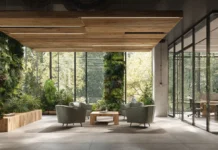
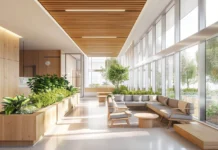
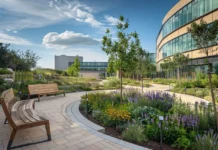
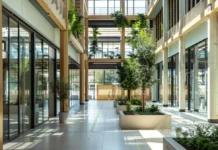
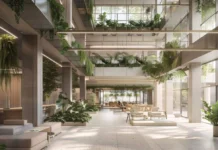

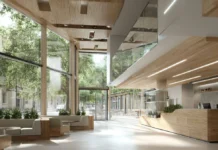
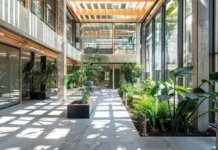
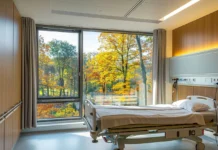
Biophilic design is an evidence-informed approach to architecture and interiors that strengthens people’s connection to nature through daylight (and, where appropriate, controlled sunlight), views, access to outdoor space, vegetation, natural materials, sensory variation, and nature-inspired spatial patterns. When integrated with building performance, it can support restorative outcomes, comfort, and perceived wellbeing, while complementing sustainability goals and, where relevant, ecology-led planning outcomes.
Unlike decorative “green aesthetics,” biophilic design draws on environmental psychology and building science. It starts from a practical observation: many contemporary buildings reduce daylight exposure, sensory variation, and everyday contact with natural settings. For study types and evidence strength, see our overview of the science behind biophilia.
Outcomes vary by context and implementation quality, and are best verified through post-occupancy evaluation (POE) and indoor-environment performance measures.
What is biophilic design?
Biophilic design is an evidence-informed approach to building design that integrates natural systems, materials, and spatial patterns to support restoration, comfort, and human performance. It is not decorative planting, green branding, or a sustainability certification on its own.
It increases meaningful exposure to nature inside and around buildings through daylight and view planning, access to vegetation and outdoor space, natural materials, and spatial patterns such as prospect and refuge. These conditions are associated in the literature to attention restoration, stress reduction, and improved comfort, though outcomes depend on baseline conditions and execution quality.
Biophilic design applies across offices, healthcare, education, homes, and urban public space. It overlaps with sustainability, but primarily targets human experience and performance outcomes rather than carbon and energy metrics.
Evidence base: This article synthesises peer-reviewed research in environmental psychology and health, plus standards guidance where relevant. Key sources include Kellert et al. (2008), Kaplan (1995), and Jimenez et al. (2021). Full citations are listed below.
For a clear breakdown of objectives and measurement, read biophilic vs sustainable vs regenerative design. Results depend on implementation quality, maintenance, and baseline site and building conditions.
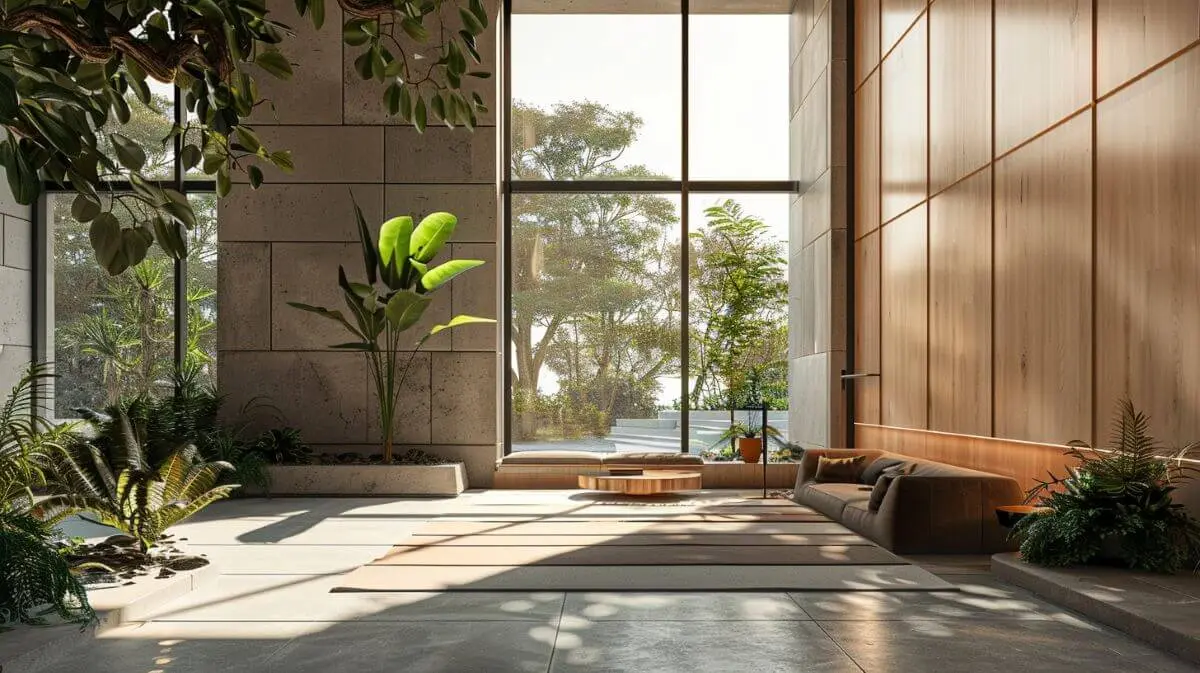
The origin of biophilic design
The biophilia hypothesis
The term biophilia was popularised by E.O. Wilson in 1984, who argued that humans evolved in natural environments and therefore possess an innate attraction to life and life-like systems.
The theory suggests that sunlight, vegetation, water, natural textures, and landscape views are biologically relevant stimuli that influence mood, stress response, blood pressure, and cognitive function.
You can read the biophilia hypothesis in E.O. Wilson’s 1984 work on biophilia.
Translation into architecture
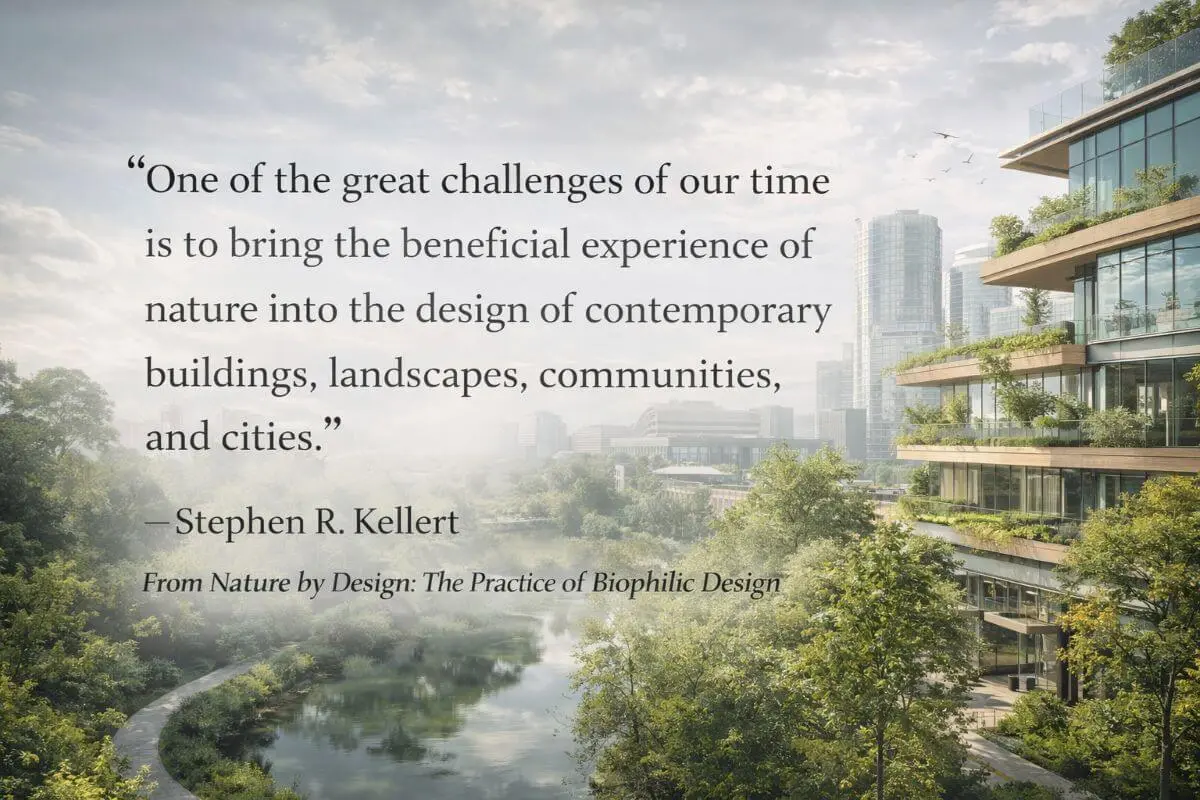
Stephen Kellert later translated this theory into architectural practice, describing biophilic design as the deliberate application of human affinity for nature in the design of built environments.
Biophilic design in the built environment connects evolutionary biology, environmental psychology, architecture, and building science. It gives designers a structured framework for integrating ecological awareness into practical building design.
(For deeper theory, Kellert remains a widely cited reference in the field.)
Defining biophilic design precisely
Biophilic design is:
- The intentional integration of natural elements and processes into built environments
- The shaping of spaces to support physiological and psychological restoration
- A framework that links design decisions to human experience and evaluation methods (e.g., POE)
It is not:
- Decorative planting without spatial integration
- The colour green used symbolically
- Environmental branding
- Certification alone
Sustainable design focuses on reducing environmental impact. Biophilic design focuses on the human–nature relationship within built space. The two overlap, but their primary objectives differ.

Why humans respond to nature
Environmental psychology
A large body of research associates nature exposure with reduced stress and improved perceived wellbeing, and with the restoration of directed attention after mental fatigue. Evidence quality and effect sizes vary by setting, study method, and baseline conditions, so claims should be framed cautiously and supported with sources.
Attention Restoration Theory is closely associated with Kaplan’s work on directed-attention fatigue and the restorative potential of nature.
Neurophysiology
Some studies suggest that viewing natural scenes and environments can be associated with physiological markers consistent with relaxation, and that natural patterns (including some fractal geometries) may be processed with lower cognitive effort in certain conditions. These findings are active research areas and should be contextualised with the specific study types and measures used.
For a research-focused overview of outcomes across settings, see Benefits of Biophilic Design (Backed by Research).
Workplace performance (what the evidence can and can’t claim)
Field studies and industry research often report positive associations between biophilic workplace features (daylight, views, vegetation, and restorative spaces) and outcomes such as self-reported wellbeing, perceived productivity, and creativity. For example, the Human Spaces research is frequently cited as reporting around 6% higher self-reported productivity and up to 15% higher self-reported creativity in workplaces with biophilic features; these figures should be treated as context-dependent and not guaranteed project outcomes.
Where planting is used, it’s important to distinguish perceived air quality and comfort from measured indoor air quality, which is typically driven by ventilation/filtration and source control rather than potted plants.
Indoor air quality note: Early NASA-funded research demonstrated that certain houseplants and their root–soil microorganisms can remove VOCs (e.g., benzene, formaldehyde, TCE) from air in sealed chamber experiments. These findings are best understood as evidence of removal potential under laboratory conditions; in real buildings, measured IAQ is typically driven by ventilation, filtration, and source control. Planting can still provide strong biophilic value through visual connection, perceived comfort, and restorative experience, but more modern research question whether potted plants improve indoor air quality.
(For a deeper evidence review and business framing, see Biophilic Design in Offices: Productivity & ROI.)
Indoor environmental quality
Many biophilic strategies interact with indoor environmental quality because they involve daylighting, glazing, shading, ventilation approaches, acoustics, and thermal comfort. These should be designed as performance-led building systems decisions, not assumed benefits. Good biophilic delivery integrates nature contact while controlling glare, overheating risk, acoustic disruption, and ventilation requirements.

Core elements of biophilic design
One widely cited framework is the 14 Patterns of Biophilic Design developed by Terrapin Bright Green in 2014. The patterns fall into three categories.
Nature in the space
Direct presence of natural systems, including:
- Plants and vegetation
- Water features (where appropriate)
- Sunlight and dynamic daylight
- Air movement and sensory variability
- Seasonal variation
Light exposure is a primary cue for circadian entrainment; appropriately timed daytime light (and reduced disruptive light at night) is associated with improved alertness and sleep outcomes.
Visible greenery can strengthen perceived connection to nature and perceived restorativeness.
Natural analogues
Indirect representations of nature through materials and form:
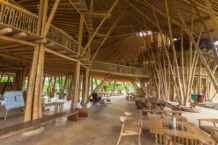
- Timber and stone
- Biomorphic forms
- Fractal patterns
- Natural colours and textures
These materials and design elements evoke natural ecosystems without requiring live biological components.
Nature of the space
Spatial configurations reflecting evolutionary habitat preferences:
- Prospect through open views and windows
- Refuge in protected corners
- Mystery through partial concealment
- Controlled risk/peril at edges and transitions
These spatial relationships influence how people experience safety, awareness, and balance within buildings.

Biophilic design versus sustainable design
Sustainable design reduces environmental impact through energy efficiency and resource management. Biophilic design prioritises restorative experience and nature connection. Frameworks such as WELL and LEED can include aspects of both, but biophilic design is best treated as a design approach that can be evaluated through POE and indoor-environment performance measures.
Applications of biophilic design
Offices
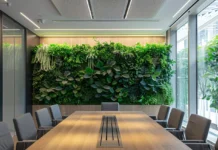
Biophilic workplace strategies can support restorative experience, comfort, and perceived wellness, especially when they prioritise daylight and views, access to planted or outdoor areas, material authenticity, and restorative micro-spaces (prospect/refuge).
In practice, outcomes depend heavily on integration with core performance drivers such as glare control, overheating risk, acoustics, ventilation/IAQ strategy, layout, and task needs. Where these fundamentals are well resolved, biophilic features are more likely to translate into improved perceived focus, satisfaction, and experience of place.
Healthcare
In hospitals and clinics, nature views, daylight, and access to gardens are frequently studied in relation to patient experience, stress reduction, and staff wellbeing. A widely cited example is Ulrich’s 1984 study, which found that post-surgical patients with a window view of nature had better recovery indicators (including shorter stays and lower use of strong analgesics) than those facing a brick wall.
Please note: Effects vary by clinical pathway, ward type, patient cohort, and operational constraints. See Biophilic Design in Healthcare for further reading.
Education
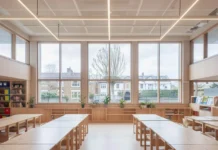
In education settings, daylight, outdoor access, and nature views are often explored for links to calm, attention, and learning conditions. Evidence in this area is typically associational and varies by age group, baseline environment, school type, and operational constraints.
Where nature contact is made reliable (e.g., consistent views to greenery, usable outdoor learning space, comfortable daylight without glare/overheating), it may support perceived behavioural regulation and learning readiness, particularly when paired with good acoustics, ventilation, and thermal comfort.
For how these principles translate into learning environments, explore Biophilic Design in Schools.
Residential
In homes, window placement, daylight quality, access to balconies or gardens, and durable natural materials can support daily restoration and comfort. Improved sleep is more plausibly linked to circadian-appropriate light exposure by day, reduced glare, and reduced disruptive light at night, rather than biophilic elements alone. In other words, biophilic measures can contribute, but lighting design and household behaviours remain key.
Urban planning
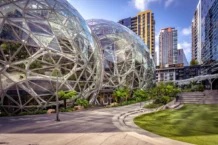
At the urban scale in city construction, parks, green/blue infrastructure, habitat corridors, and tree canopy can mitigate heat through shading and evapotranspiration; impacts vary by canopy cover, placement, species, and local climate.
Neighbourhood benefits depend on mechanisms such as heat-risk reduction, stormwater management, air/noise buffering, and equitable access to high-quality public space.
Biophilic urbanism is most defensible when it links nature-based interventions to measurable ecological outcomes and equitable access, rather than treating greenery and biodiversity as universally beneficial by default.

Economic case for biophilic design
Productivity and performance
The economic case in workplaces is typically framed around the cost of discomfort and reduced performance in high-value roles. Evidence from large workplace surveys suggests that offices with natural elements are associated with higher self-reported productivity and creativity, though results are context-dependent and not guaranteed.
For example, the Human Spaces study (7,600 office workers across 16 countries) reports ~6% higher self-reported productivity and up to ~15% higher self-reported creativity in environments with natural elements; these figures should be treated as indicative and interpreted alongside baseline conditions and other workplace factors.
Real estate and asset value
Nature-related features can translate into commercial and residential value where markets price amenity. UK evidence using hedonic pricing finds that proximity to public green space is associated with a measurable house-price premium in England (with magnitude varying by property type and distance).
For offices, research has found that higher daylight levels can be associated with a rent premium (e.g., a 5–6% premium reported in a large office market study), suggesting tenants value daylight and related environmental qualities.
Because these effects vary by location, supply, and tenant demand, value claims should be treated as market-dependent and evidenced locally where possible.
Healthcare operations and cost implications
In healthcare, the economic argument is usually indirect: if design features support better recovery indicators and patient experience, they may reduce length of stay or resource use in specific contexts. A widely cited example is Ulrich’s 1984 study, which found that post-surgical patients with a nature view had shorter hospital stays and used fewer potent analgesics than matched patients with a brick-wall view.
Financial impacts are not automatic and depend on pathway, occupancy, staffing models, and operational constraints, so cost claims should be framed as potential operational implications rather than guaranteed savings.
Implementation strategies
Biophilic design can be introduced at multiple scales:
- Low-cost: daylight and view optimisation (with glare/overheating control), reconfiguring layouts to increase nature visibility, specifying authentic natural materials
- Moderate: targeted planting schemes with maintenance plans, outdoor terrace/courtyard upgrades, dynamic lighting that supports comfort and circadian-appropriate exposure
- Advanced: structural daylighting systems (e.g., skylights), integrated landscape/ecological infrastructure, climate-responsive design
The right level depends on budget, operational capacity, regulatory context, and project objectives. For budgeting and retrofit realities, see Cost of Biophilic Design.

Common misconceptions
It is just plants
Plants are one component. Spatial configuration, material authenticity, daylight quality, and ventilation strategy are equally important.
It is a trend
The foundation lies in evolutionary biology and decades of research.
It is only for luxury projects
Many biophilic strategies are compatible with constrained budgets when planned early.
It’s a gimmick
In England, Building Regulations guidance such as Approved Documents Part L (energy), Part O (overheating) and Part F (ventilation) can constrain or shape daylighting, glazing, and ventilation decisions in biophilic projects, making performance-led integration essential.
For UK-specific delivery constraints: BREEAM, Building Regulations, retrofit stock and climate, see Biophilic Design in the UK.
FAQs on biophilic design
Is biophilic design just plants?
No. Plants are one component. Biophilic design also includes natural light, views, ventilation patterns, spatial layouts such as prospect and refuge, and materials such as timber and stone. The goal is a reliable experience of nature, not decoration.
What is the difference between biophilic design and sustainable design?
Sustainable design primarily reduces environmental impact through energy, carbon, and resource efficiency. Biophilic design primarily improves human experience and wellbeing by strengthening connection to nature inside and around buildings. They overlap, but they optimise different outcomes.
What are the 14 Patterns of Biophilic Design?
The 14 Patterns framework groups biophilic strategies into nature in the space, natural analogues, and nature of the space. It provides a practical structure for selecting design elements such as vegetation, water, natural materials, fractal patterns, prospect, refuge, and mystery.
Does biophilic design improve productivity?
Evidence from workplace studies often associates biophilic conditions such as daylight and nature views with improved focus and perceived performance. Results vary by context, baseline conditions, and execution quality, so benefits should be evaluated alongside indoor environmental quality and workplace design factors.
Where is biophilic design used?
Biophilic design is used in offices, healthcare settings, education environments, homes, and urban public space. The strategy differs by context, for example healthcare often focuses on recovery and stress reduction, while schools often focus on attention and behavioural stability.
Key takeaways
- Biophilic design integrates natural systems into built spaces to support cognitive performance, restorative experience, comfort, and perceived wellbeing.
- Light exposure is a primary cue for circadian entrainment and is associated with sleep and alertness outcomes, but must be balanced with glare control and overheating risk.
- Nature exposure is frequently associated with stress biomarkers reduction and attention restoration, though outcomes vary by context and study method.
- Workplace benefits are often reported as positive associations (including self-reported productivity/creativity in some research), not guaranteed outcomes.
- Indoor environmental quality is primarily a building-systems issue (ventilation, thermal comfort, acoustics, lighting); biophilic strategies should be integrated with these performance requirements.
- Maintenance planning sustains biophilic intent (plant health, water hygiene, lighting controls), but do not imply plants keep air “safe.”
Conclusion
Biophilic design is a research-informed architectural approach that integrates nature contact into built environments to support restorative experience and comfort. It is grounded in multidisciplinary research and implemented through deliberate design decisions, then validated through post-occupancy evaluation and performance measures.
As urbanisation intensifies and indoor living dominates modern society, biophilic design represents not aesthetic preference but a practical strategy for strengthening the relationship between humans, buildings, and the natural world.
If any of the terminology here is unfamiliar, use our biophilic design glossary as a quick A–Z reference
References
- Blume, C., Garbazza, C. & Spitschan, M. (2019) ‘Effects of light on human circadian rhythms, sleep and mood’, Somnologie, 23(3), pp. 147–156.
- Siraji, M.A., Kalavally, V., Schaefer, A. & Haque, S. (2022) ‘Effects of Daytime Electric Light Exposure on Human Alertness and Higher Cognitive Functions: A Systematic Review’, Frontiers in Psychology.
- CIBSE (n.d.) Post-Occupancy Evaluation (POE) – Carbon Bites.
- Cummings, B.E. & Waring, M.S. (2020) ‘Potted plants do not improve indoor air quality: A review and analysis of reported VOC removal efficiencies’, Journal of Exposure Science & Environmental Epidemiology.
- Government of the United Kingdom (n.d.) Approved Document L: Conservation of fuel and power. GOV.UK.
- Human Spaces (2015) The Global Impact of Biophilic Design in the Workplace.
- Jimenez, M.P., et al. (2021) ‘Associations between nature exposure and health: A review of the evidence’, International Journal of Environmental Research and Public Health.
- Jo, H., et al. (2019) ‘Physiological and psychological benefits of viewing nature: A systematic review’, International Journal of Environmental Research and Public Health.
- Kaplan, S. (1995) ‘The restorative benefits of nature: Toward an integrative framework’, Journal of Environmental Psychology.
- Kellert, S.R. (2015) The Practice of Biophilic Design.
- Kellert, S.R., Heerwagen, J. & Mador, M. (eds.) (2008) Biophilic Design: The Theory, Science and Practice of Bringing Buildings to Life. Wiley.
- National Aeronautics and Space Administration (NASA) (1993) Interior Landscape Plants for Indoor Air Pollution Abatement. NASA Technical Reports Server.
- Office for National Statistics (ONS) (2018) ‘Estimating the impact urban green space has on property prices’, Economic Review.
- Office for National Statistics (ONS) (2019) ‘Urban green spaces raise nearby house prices by an average of £2,500’.
- Terrapin Bright Green (2014) 14 Patterns of Biophilic Design: Improving Health & Well-Being in the Built Environment.
- Turan, I., et al. (2020) ‘The value of daylight in office spaces’, Building and Environment.
- Ulrich, R.S. (1984) ‘View through a window may influence recovery from surgery’, Science.
- Wilson, E.O. (1984) Biophilia. Harvard University Press.
- Yao, W., Zhang, X. & Gong, Q. (2021) ‘The effect of exposure to the natural environment on stress reduction: A meta-analysis’, Urban Forestry & Urban Greening, 57, 126932.