








Biophilia describes a proposed human tendency to attend to, affiliate with, and feel drawn toward life and life-like processes. In design and public health research, it is often discussed as a biologically plausible hypothesis linked to evolutionary perspectives and studied across environmental psychology, stress physiology, neuroscience, and epidemiology.
Research across these fields helps explain why nature exposure is frequently associated with stress recovery and cognitive restoration. Findings are context-dependent and vary by study design, dose, and baseline conditions.
If you want a practical definition of how this translates into buildings, start with our guide on what biophilic design is and what it includes in real projects.
This article explains the science behind biophilia, including:
- The evolutionary origins of environmental preference
- Neurological responses to natural stimuli
- Physiological stress reduction mechanisms
- Cognitive restoration theory
- The role of fractal geometry
- Implications for architecture and design in urban environments
Quick Summary
Biophilia describes a proposed human affinity for life and life-like processes. Research across environmental psychology, stress physiology, and neuroscience helps explain why nature exposure is often associated with stress recovery and attention restoration, and why light exposure regulates circadian rhythms.
These mechanisms inform biophilic architecture by translating nature cues (daylight and views, vegetation, fractal-like complexity, and prospect/refuge spatial conditions) into performance-led strategies that can be evaluated through post-occupancy and indoor-environment metrics.
For the applied implementation framework most widely used by designers, see the 14 patterns of biophilic design and how they map to real spatial strategies.

The origin of the biophilia hypothesis
The term biophilia was popularised by biologist Edward O. Wilson in his 1984 book, where he described biophilia as a tendency to focus on life and life-like processes.
Wilson argued that because humans evolved in natural environments for most of our species history, certain environmental cues may feel especially salient and restorative. This is not a claim that one landscape type is universally preferred, but that some attributes (legibility, refuge, resource cues) can influence experience.
For design readers, the next step is understanding how biophilia becomes measurable building strategy, our benefits of biophilic design backed by research summarises outcomes across workplaces, schools, and healthcare.
Evolutionary biology and environmental preference
Evolutionary adaptation
Human sensory systems evolved under conditions where specific habitat signals affected survival.
- Open landscapes supported threat detection and navigation
- Protected enclosures supported retreat and recovery
- Moving water signalled resources
- Vegetation and plant diversity signalled food availability and shelter
Savanna hypothesis and cross-cultural preferences
Some research in evolutionary psychology suggests people show preference for landscapes that resemble savanna-like environments. These settings often include scattered trees, open views, water, and moderate complexity. The claim is not that humans prefer one landscape type universally, but that certain environmental attributes can feel intuitively legible to the human brain.

Environmental psychology and attention restoration
One of the strongest foundations for biophilia in environmental psychology comes from Attention Restoration Theory, developed by Rachel and Stephen Kaplan.
Attention fatigue
Modern learning and work require sustained directed attention. Overuse can lead to mental fatigue, irritability, and reduced decision capacity.
Restorative environments
Natural environments often provide soft fascination. This is a form of attention engagement that restores cognitive capacity without demanding effort.
Attention restoration can improve working memory, executive function, and emotional regulation. Built spaces that include nature views, daylight, or natural pattern elements can support similar restoration effects when designed coherently.
Neurophysiology of nature exposure
Neuroscience studies report measurable changes in brain activity when people view natural environments compared to visually monotonous urban scenes.
Research using fMRI and related methods has reported differences in stress-related activation patterns and autonomic markers across natural versus urban exposures, depending on the study design and stimulus.
Some intervention research has reported reduced amygdala activity after exposure to natural environments compared with urban environments, consistent with altered stress-related processing (Sudimac et al., 2022). Effects are context-dependent and not universal.
The amygdala plays a role in fear and stress processing. Reduced activation aligns with reduced anxiety and improved calm states, although outcomes vary depending on study conditions and individual differences.
Stress reduction theory
Roger Ulrich’s Stress Reduction Theory proposes that humans have evolved adaptive responses to natural settings that reduce stress quickly and often unconsciously.
Empirical findings
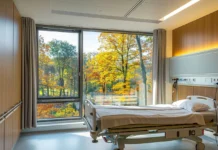
In Ulrich’s 1984 study of post-surgical patients, those with a window view of trees had shorter hospital stays and required fewer strong analgesics than matched patients facing a brick wall; records also reflected fewer negative evaluative notes.
Findings are specific to the cohort and setting and should not be treated as guaranteed outcomes across healthcare contexts.
Healthcare is one of the strongest evidence domains for biophilia; our sector guide on biophilic design in healthcare explores recovery outcomes, staff stress, and clinical design constraints in more depth.

Fractal geometry and cognitive processing
Nature contains fractal patterns (repeating structure across scales). Experimental research suggests that exposure to mid-range fractal complexity can be associated with improved physiological recovery markers (e.g., heart rate recovery, skin conductance responses), though findings depend on the fractal dimension, presentation mode, and participant factors.
In architecture and interior design, fractal-like elements can be introduced through patterning, textures, and forms, but the effect depends on coherence, scale, and context. Overuse can produce visual noise rather than restoration.
Circadian biology and light exposure
Light exposure is a primary environmental cue for circadian entrainment. Appropriately timed daytime light exposure and reduced disruptive light at night are associated with sleep and alertness outcomes; design implications include daylight access, glare control, and circadian-supportive electric lighting strategies.

Air quality, plants, and perceived environmental quality
Indoor plants and greenery can influence perceived indoor air quality and psychological comfort. (Abbasoğlu et al., 2025) While plants should not be treated as a substitute for ventilation/filtration at building scale, perceptions of freshness and comfort can still matter for experience and stress appraisal.
When people perceive a space as fresher, calmer, and more natural, stress responses can reduce even if the objective air quality improvement is modest. The effect is partly environmental psychology and partly physiological response to cues of safety and comfort.
Prospect and refuge in human spaces
Prospect–refuge theory proposes that people often prefer environments that offer both outward views (prospect) and protected positions (refuge). Evidence syntheses note that perceived safety and preference can be influenced by these spatial characteristics, although results vary by context and measurement approach.
The theory suggests people feel safer and more comfortable in spaces that offer clear views and protected retreat. These preferences reflect survival instincts shaped by evolution.
In architecture, this can be achieved through sightlines, seating placement, partial enclosure, and spatial zoning. The goal is legible movement, not complexity for its own sake.
Urbanisation and reduced nature exposure
Modern urban life increases indoor time, screen exposure, and artificial lighting while reducing daily interaction with natural ecosystems. Some researchers refer to this pattern as a form of “nature deficit”, a term popularised in 2005 to describe the perceived costs of disconnection from nature (not a formal medical diagnosis).
Some studies associate reduced everyday nature contact with lower wellbeing and higher stress-related outcomes, although causality and effective “dose” remain debated.
Convergence across disciplines
Biophilia is supported by interdisciplinary research spanning evolutionary biology, neuroscience, environmental psychology, public health, cognitive science, and urban planning. These fields converge on a simple principle.
Humans respond to natural cues because human biology developed in natural environments.
Applied frameworks such as WELL and Living Future standards incorporate nature and health concepts into measurable strategies, but biophilia itself is the underlying scientific rationale rather than a certification.
Limitations and ongoing research
Biophilia research continues to develop. Limitations include variation in study design, cultural differences in preference, and the difficulty of isolating variables in real buildings. Even so, the convergence of findings across disciplines strengthens the hypothesis.
Why the science matters for architecture and design
Understanding biophilia scientifically prevents superficial application and improves outcome credibility.
- Evidence-based design strengthens stakeholder confidence
- Clear mechanisms improve implementation quality
- Measurable outcomes support investment justification
Biophilic design is not about aesthetics alone. It is about aligning architecture with human biology to improve health, wellbeing, and long-term comfort in the environments where people live, learn, and work.
FAQs
What is biophilia?
Biophilia is the innate human affinity for life and life-like systems. It describes why people respond positively to natural environments and why nature cues can support stress biomarkers reduction and wellbeing.
Is biophilia scientifically supported?
Yes. Evidence spans evolutionary biology, environmental psychology, neuroscience, and physiology. While study methods vary, multiple disciplines converge on similar mechanisms for stress regulation and cognitive restoration.
How does nature reduce stress?
Nature exposure is associated with reduced stress activation and increased parasympathetic response. This can influence indicators such as heart rate, blood pressure, and perceived calm, depending on context.
What is Attention Restoration Theory?
Natural environments are often described as supporting recovery from directed attention fatigue. In some contexts, attention restoration is associated with improved performance on attention-demanding tasks and perceived mental clarity, though effects vary by setting and measurement.
A foundational reference for Attention Restoration Theory is Stephen Kaplan’s 1995 paper on the restorative benefits of nature and directed attention fatigue
This mechanism is one reason biophilic design can be so impactful in learning and work settings, see how it’s applied in biophilic design in schools and in offices.
How does biophilia influence architecture and design?
Biophilia informs biophilic design by translating nature cues into built environments through daylight, nature views, greenery, natural materials, fractal patterns, and spatial layouts such as prospect and refuge.
Key takeaways
- Biophilia describes an innate human affinity for nature shaped by evolution.
- Nature exposure supports stress reduction through measurable physiological pathways.
- Attention Restoration Theory explains how natural environments restore directed attention capacity.
- Daylight supports circadian rhythm regulation, influencing sleep quality and alertness.
- Fractal patterns and coherent natural complexity can reduce cognitive load.
- Prospect and refuge spatial conditions increase perceived safety and comfort in buildings.
- Biophilic design applies these mechanisms to architecture through natural cues, not aesthetics alone.
Conclusion
The science behind biophilia shows that humans are biologically attuned to natural environments. Evolution, neurological response, stress physiology, and environmental psychology collectively support the idea that natural stimuli improve wellbeing and reduce stress.
As urban environments expand and daily interaction with ecosystems and biodiversity declines, biophilic design offers a practical framework for restoring beneficial natural cues inside buildings.
Biophilia bridges evolution, neuroscience, psychology, and architecture. The evidence base is cumulative, and its design implications are operational.
References (Science pack)
- Kaplan, S. (1995)‘The restorative benefits of nature: Toward an integrative framework’, Journal of Environmental Psychology, 15(3), pp. 169–182.
- Ulrich, R.S., Simons, R.F., Losito, B.D., Fiorito, E., Miles, M.A. & Zelson, M. (1991)
‘Stress recovery during exposure to natural and urban environments’, Journal of Environmental Psychology. - Sudimac, S., Sale, V. & Kühn, S. (2022)‘A one-hour walk in nature reduces amygdala activity in women’.
- Ibrahim, A., et al. (2025)‘The role of fractal patterns in modulating stress response and recovery in virtual indoor environments’, Building and Environment.
- Bies, A.J., et al. (2016)
‘Aesthetic responses to exact fractals driven by physical complexity’. - Dosen, A.S. & Ostwald, M.J. (2016)‘Evidence for prospect-refuge theory: A meta-analysis of the findings of environmental preference research’
, City, Territory and Architecture. - Dosen, A.S. & Ostwald, M.J. (2013)‘Prospect and refuge theory: Constructing a critical definition for architecture and design’.
- Abbasoğlu, M.S., et al. (2025)‘Effects of indoor plants on perceptions about indoor air quality and subjective well-being’, Journal of Building Engineering.
- Children & Nature Network (n.d.)‘What is Nature-Deficit Disorder?’.
- Ulrich, R.S. (1984)‘View through a window may influence recovery from surgery’, Science.