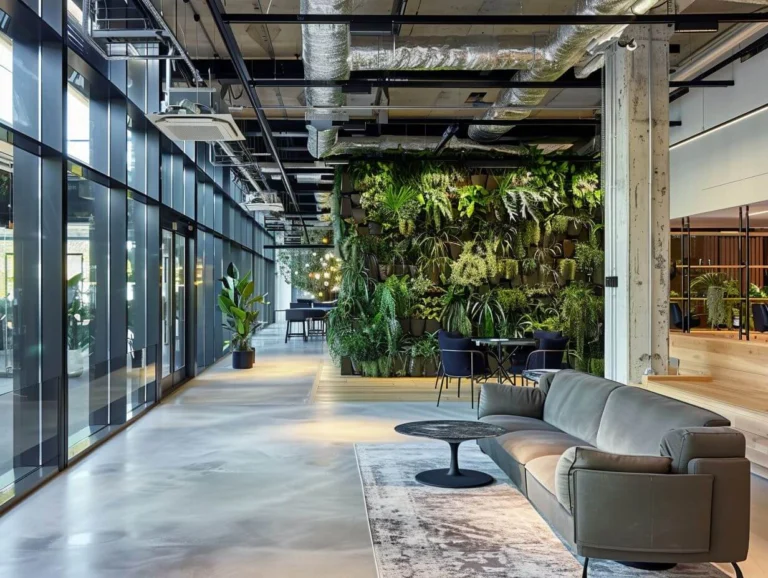





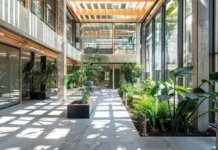

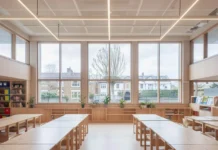
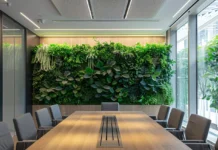

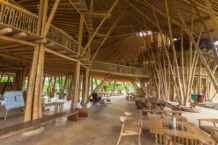
The benefits of biophilic design are grounded in research linking nature exposure to stress recovery, attention restoration, and circadian regulation. Biophilic design is an evidence-informed approach to architecture and interiors that aims to strengthen connection to nature through access to daylight, controlled sunlight where appropriate, views to greenery, outdoor access, natural materials, and nature-referencing spatial patterns.
When well integrated, these strategies may support restorative experience, perceived wellbeing, and user satisfaction. Reported outcomes vary by context, baseline conditions, and measurement method, and are strongest when nature cues are layered with high-performing environmental fundamentals.
Biophilic design is not simply an aesthetic trend. It draws on environmental psychology, stress physiology, and building science, and is typically evaluated in practice using post-occupancy evaluation (POE) alongside indoor environmental metrics.
WorldGBC notes that workplace design factors (including indoor air quality, comfort, lighting/daylight and biophilic considerations) can influence health, wellbeing, and productivity outcomes.
Quick summary
Research commonly associates nature exposure and nature cues with stress recovery and attention restoration, and recognises light exposure as a primary cue for circadian entrainment. In buildings, benefits are typically assessed via POE, user surveys, and indoor-environment metrics (air, thermal, acoustic, visual).
Plants can contribute strongly to perceived nature connection and comfort, but do not substitute for ventilation/filtration at building scale.
Some workplace research reports self-reported productivity/creativity uplifts in environments with biophilic features; effect size and attribution are context-dependent.
Evidence strength at a glance
- Strong: stress recovery; attention restoration; circadian-light effects
- Moderate: perceived wellbeing and satisfaction; workplace self-reported outcomes
- Indicative/indirect: market demand; creativity; energy use; stewardship
This page summarises reported outcomes linked to nature exposure and biophilic cues. It does not treat these as guaranteed project results; outcomes depend on baseline IEQ, implementation quality, and measurement method.
For a clear definition and examples across building types, start with What Is Biophilic Design.
If you want the underlying mechanisms (stress physiology, attention restoration, and circadian regulation) see The Science Behind Biophilia.
To understand how these outcomes translate into design moves, the 14 patterns of biophilic design explained breaks the framework down pattern by pattern.

How biophilic benefits are measured
Organisations typically quantify outcomes using:
- Occupant surveys and post-occupancy evaluation (POE)
- Absenteeism and retention (where HR data can be linked to workplace changes)
- Cognitive performance testing (where feasible)
- Indoor environmental quality (IEQ) measures such as ventilation/IAQ, temperature, acoustics, and light
- Healthcare metrics such as length of stay and medication use (where data access allows)
Measurement method determines claim strength. Post-occupancy evaluation (POE) is widely used to assess how buildings perform after occupation and to compare design intent with real outcomes.
Where health or performance outcomes are discussed, it’s important to distinguish biophilic features from IEQ fundamentals (ventilation, CO₂/VOCs, thermal comfort, glare and acoustics). Experimental research has linked ventilation/CO₂/VOC exposure conditions to cognitive performance under controlled exposure scenarios.(5) In practice, IEQ is typically evaluated alongside any biophilic interventions.
Health benefits of biophilic design (what the evidence supports)
Biophilic design is most credibly linked to health through stress recovery and restorative experience. Across environmental psychology and public health literature, nature exposure is frequently associated with reduced stress-related outcomes and improved perceived wellbeing, although effect size and causality vary by study design, exposure “dose,” and baseline conditions.(1)
1) Stress recovery and physiological regulation
Experimental and field research has reported stress-recovery effects during or after exposure to natural settings compared with urban conditions, including physiological changes consistent with autonomic recovery.(2)
2) Healthcare: recovery indicators
In clinical contexts, one of the most cited findings is Ulrich’s 1984 study of post-surgical patients: those with a window view of trees had shorter hospital stays and required fewer strong analgesics than matched patients facing a brick wall; records also reflected fewer negative evaluative notes. These outcomes are specific to the cohort and setting and should not be treated as guaranteed results across all healthcare environments.(3)
3) Indoor plants: wellbeing and perceived environment
Indoor plants can contribute to perceived nature connection, comfort, and aspects of workplace experience. Field research across multiple office organisations has reported changes in office-worker outcomes after introducing plants, although effects vary by office context and implementation4.
However, plants should not be treated as a substitute for ventilation and filtration at building scale. Reviews note that typical potted plants do not reliably deliver meaningful measured IAQ improvements under real-world conditions compared with ventilation/filtration and source control.(9)
4) Health symptoms and indoor environmental quality (IEQ)
Many health and performance outcomes in buildings are mediated by indoor environmental quality (IEQ) variables. Experimental studies have demonstrated associations between ventilation rate, CO₂ concentration, VOC exposure, and cognitive function. (5)
Biophilic design often intersects with these determinants (particularly through daylighting, operability, and material selection), so IEQ and biophilic mechanisms should be treated as related but distinct.

Improved cognitive performance and attention
Biophilic design can support perceived focus and attention, particularly in environments with high cognitive demand, where daylight, views, and restorative spaces are integrated coherently.
Attention Restoration Theory (ART) proposes that natural stimuli can help people recover from directed attention fatigue(13). Research also suggests that exposure to fractal patterns and coherent natural complexity can influence visual preference and, in some settings, stress-related processing under controlled conditions, although outcomes depend on stimulus characteristics and context.(14)
Workplace studies commonly report perceived improvements in concentration where daylight and nature views are present. Some organisations report self-reported productivity improvements, often discussed in the 6–15% range in industry literature; effect size varies and attribution can be complex. (7)
Daylight access through well-placed windows is also discussed in relation to alertness and task engagement, although performance outcomes are influenced by glare control, thermal comfort, acoustics, and workplace planning. (8)
Reduced absenteeism and improved workplace satisfaction
Workplace experience influences retention, absenteeism, and satisfaction. Biophilic strategies can contribute to perceived environmental quality, psychological comfort, and experience of place, particularly when paired with strong IEQ performance (light, air, acoustics, and thermal comfort).
Claims about engagement are strongest when organisations combine workplace survey findings with HR metrics over time rather than relying on perception measures alone.
Improved mental health and emotional wellbeing
Modern indoor lifestyles can reduce everyday nature contact. In research literature, nature exposure is frequently associated with improved mood and reduced stress-related outcomes, although causality and effect size vary by study type and baseline conditions. (1)
To keep claims precise, this article focuses on psychological wellbeing (stress recovery, mood, perceived restoration) rather than implying treatment effects for clinical mental health conditions.

Circadian rhythm regulation, visual comfort, and sleep quality
Light exposure is a primary cue for circadian entrainment, and timing, intensity, duration, and spectral composition all matter. Reviews summarise that light can support alertness and sleep-related outcomes when exposure is appropriately timed, but can also disrupt circadian rhythms and sleep when delivered at the wrong time (especially in the evening/night). (10)
It’s useful to distinguish daylight from sunlight in building design: daylight includes diffuse sky light and reflected natural light, while sunlight refers to direct solar exposure. Both can contribute to circadian stimulus, but they have different implications for glare, overheating risk, and controllability (shading, view management, and thermal comfort strategies).
From a circadian perspective, daylight access often helps achieve higher melanopic stimulus (i.e., circadian-effective light at the eye) than typical static electric lighting when designed well. Standards and design frameworks increasingly reference melanopic metrics (e.g., melanopic EDI) to describe circadian-relevant light targets.(11)
Visual comfort matters. Bright, poorly controlled electric lighting, glare, and (in some settings) low-frequency fluorescent flicker have been associated with eyestrain and headache complaints in field research, particularly where lighting cannot be adequately controlled. This is why circadian-supportive lighting should be paired with glare control, dimming, and user-adjustability rather than treated as “more light is always better.” (12)
Circadian-aligned lighting strategies aim to support alertness by day and reduce disruptive exposure by night, and are commonly discussed for healthcare and shift-work environments. A widely cited field study reported ~15% more time spent on work-related tasks in windowed offices compared with non-windowed offices (a performance proxy, not a direct circadian measure). (8)
Standards and frameworks such as WELL include circadian lighting considerations within broader health frameworks.
If you’re comparing standards and what they actually measure, see WELL vs LEED vs Living Building Challenge.
Improved indoor environmental quality
Biophilic strategies often overlap with indoor environmental quality (IEQ) decisions such as daylight distribution, acoustic conditions, thermal stability, and ventilation approaches. The mechanism here is IEQ performance, which can co-occur with biophilic intent but should not be conflated with it.
Controlled research has linked ventilation/CO₂/VOC exposure conditions to cognitive performance under experimental scenarios, and “green-certified” building studies have reported differences in cognitive scores and symptoms alongside IEQ differences. (5)(6)
In practice, IEQ improvements should be assessed through monitoring and post-occupancy evaluation, especially where health or performance claims are being made.

Secondary and indirect benefits (context-dependent)
- Market demand and asset value (market-dependent): Amenity, daylight, and perceived quality may influence retention and desirability in some markets. Effects are location- and demand-specific and should be evidenced locally.
- Creativity and innovation (indicative): Some studies associate nature exposure with measures of divergent thinking and cognitive flexibility. Outcomes vary by exposure type, task design, and baseline conditions.
- Energy performance (indirect, design-dependent): Daylighting and natural ventilation strategies can reduce mechanical loads when balanced against glare, overheating risk, and comfort requirements.
- Environmental awareness (long-term): Visible ecological systems and seasonal change may support pro-environmental attitudes over time, although effects are typically behavioural and cultural rather than immediate operational metrics.
Summary of benefits of Biophilic Design
- Stress recovery and restorative experience (context-dependent)
- Improved perceived focus and attention in some settings
- Sleep/alertness outcomes linked to circadian-aligned light exposure
- Workplace satisfaction and experience of place (often self-reported)
- Healthcare recovery indicators in specific clinical contexts (e.g., nature views)
- Indoor environmental quality benefits where IEQ fundamentals improve
- Market appeal where user experience drives demand (market-dependent)
- Ecological awareness where systems are visible

Key takeaways
- Nature exposure is frequently associated with stress recovery and restorative experience.
- Daylight and views can support perceived focus and attention, particularly when glare and comfort are controlled.
- Light exposure is a primary cue for circadian entrainment; timing and intensity matter.
- IEQ fundamentals (air, thermal, acoustic, visual comfort) mediate many health and performance outcomes in buildings.
- Benefits are measured through POE, surveys, HR metrics (where available), and IEQ monitoring.
FAQs
What are the main benefits of biophilic design?
Commonly reported benefits include stress recovery/restorative experience, improved perceived focus and comfort, sleep/alertness outcomes linked to circadian-aligned lighting, and improved workplace experience. Results are context-dependent and influenced by implementation quality.
Is there evidence that biophilic design increases productivity?
Some workplaces report self-reported productivity improvements after improving daylight and nature exposure, often discussed in the 6–15% range in industry literature. Results vary and are influenced by baseline conditions and measurement methods. (Human Spaces, 2015)
What is the strongest evidence base for biophilic design outcomes?
Healthcare and environmental psychology provide strong examples, including studies linking nature views to recovery indicators and experimental work on stress recovery and attention restoration. (Ulrich, 1984) (Ulrich et al., 1991) (Kaplan, 1995)
How do organisations measure biophilic design impact?
Common methods include POE and occupant surveys, indoor environmental monitoring, absenteeism and retention tracking, and outcome metrics such as healthcare length of stay where available.
Is biophilic design the same as sustainable design?
No. Biophilic design prioritises human experience and nature connection. Sustainable design features prioritise environmental impact reduction. They can overlap through daylighting and ventilation strategies.
What does biophilic design include in practice?
In practice, biophilic design combines nature cues and environmental performance. Cues can include daylight and sunlight access, views to greenery, access to outdoor space, planting, water where appropriate, natural materials such as timber and stone, tactile textures, and sensory variability (air movement, soundscapes).
Spatial conditions such as prospect and refuge can also shape perceived comfort, safety, and tranquillity. These features influence how spaces feel—often described in terms of calm, harmony, and connection to place, while outcomes depend on implementation quality and baseline IEQ.
Conclusion
Biophilic design is best understood as a research-informed approach to bringing nature cues into built environments in ways that support restorative experience and comfort. Evidence is strongest where nature exposure pathways (stress recovery and attention restoration) are integrated with IEQ fundamentals and evaluated post-occupancy.
The strongest outcomes occur when interventions are integrated, maintained, and measured, and when claims are aligned with evidence strength (physiological findings vs self-report vs operational metrics).
References
- Jimenez, M.P., et al. (2021) ‘Associations between nature exposure and health: A review of the evidence’, International Journal of Environmental Research and Public Health.
- Ulrich, R.S., Simons, R.F., Losito, B.D., Fiorito, E., Miles, M.A. & Zelson, M. (1991) ‘Stress recovery during exposure to natural and urban environments’, Journal of Environmental Psychology.
- Ulrich, R.S. (1984) ‘View through a window may influence recovery from surgery’, Science.
- de Vries, S., et al. (2023) ‘Indoor plants and office worker outcomes: A field study’.
- Allen, J.G., et al. (2016) ‘Associations of cognitive function scores with carbon dioxide, ventilation, and volatile organic compound exposures in office workers’, Environmental Health Perspectives.
- MacNaughton, P., et al. (2017) ‘The impact of working in green-certified buildings on cognitive function and health’, Building and Environment.
- Human Spaces (2015) ‘The Global Impact of Biophilic Design in the Workplace’.
- Heschong Mahone Group (2002) ‘Daylighting and Productivity: A Field Study’.
- Cummings, B.E. & Waring, M.S. (2020) ‘Potted plants do not improve indoor air quality: A review and analysis of reported VOC removal efficiencies’, Journal of Exposure Science & Environmental Epidemiology.
- Blume, C., Garbazza, C. & Spitschan, M. (2019) ‘Effects of light on human circadian rhythms, sleep and mood’, Somnologie, 23(3), pp. 147–156.
- Soler, D. (2021) ‘Melanopic metrics and circadian-effective light’.
- Winterbottom, M. & Wilkins, A. (2009) ‘Lighting and discomfort in offices’, Journal of Environmental Psychology.
- Kaplan, S. (1995) ‘The restorative benefits of nature: Toward an integrative framework’, Journal of Environmental Psychology, 15(3), pp. 169–182.
- Bies, A.J., et al. (2016) ‘Aesthetic responses to exact fractals driven by physical complexity’.
Evidence notes
Biophilic outcomes vary by context. Reported effects depend on baseline building conditions, how “nature exposure” is defined, measurement method (survey vs physiological vs controlled exposure), and whether strategies are layered (light, air, acoustics, spatial design) and maintained over time.
Where possible, we distinguish between physiological findings, self-reported experience, and operational metrics such as absenteeism or POE results.