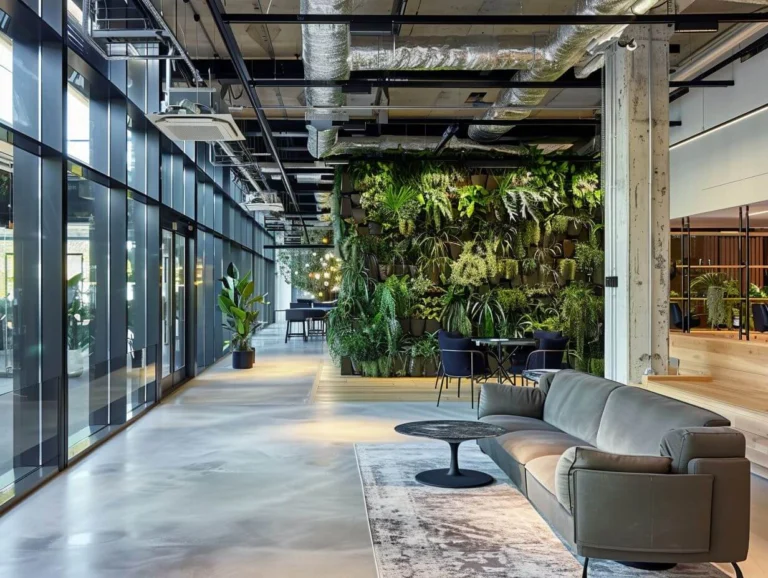







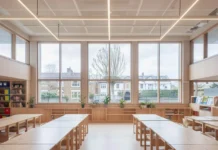
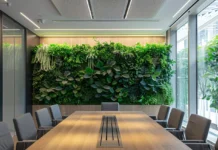

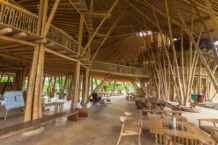
Biophilic design is frequently presented as “bringing nature into buildings.” In practice, biophilic design in the built environment refers to the deliberate integration of nature exposure pathways across architecture, interior environments, landscape and urban design, aimed at supporting stress recovery, attention restoration and perceived wellbeing outcomes, alongside strong indoor environmental quality (IEQ) performance.
Here’s what the evidence reliably supports, what’s still noisy, and what tends to make biophilic ideas fail in real project delivery (O&M, moisture risk, equity, and basic IEQ).
Use this page for: (1) an evidence base you can cite, (2) a measurement lens for POE/IEQ, and (3) an implementation workflow that teams can apply.
Related foundations:
What is biophilic design?
14 Patterns explained
Benefits backed by research
Quick summary
Across peer-reviewed syntheses, the strongest and most consistent pathways supported for biophilic design are stress recovery, restoration of directed attention, and affect/mood shifts. The effect size isn’t the problem, delivery is. Most disappointments trace back to ‘nice feature, no maintenance plan
Evidence is strongest where nature contact is repeated, visible in daily routines, and supported by operations and maintenance plans, not isolated features.
What “built environment” means in biophilic practice
In biophilic practice, “built environment” is broader than a single building interior. It includes the systems and environments that shape everyday exposure to light, views, vegetation, and sensory conditions across multiple scales:
- Architecture: façade design, daylight strategy, views, operability, thermal and acoustic performance.
- Interior architecture: materials, tactile and acoustic experience, spatial zoning (prospect/refuge), wayfinding and legibility.
- Landscape and public realm: courtyards, gardens, canopy, water management, biodiversity and habitat cues.
- Urban design and planning: access to greenspace, corridor connectivity, street trees, density constraints, equity of access.
- Retrofit: upgrading views/daylight, reconfiguring circulation and refuge spaces, low-disruption planting strategies, maintenance planning.
This is why biophilic outcomes are rarely attributable to a single feature (e.g., “add plants”). The most reliable effects are linked to repeated exposure and layered delivery: views, daylight, materials, spatial experience and IEQ fundamentals working as an integrated system.

Evidence Strength Overview
| Outcome Domain | Evidence Strength | Typical Effect Size | Key Evidence Sources | Practitioner Implication |
|---|---|---|---|---|
| Stress Recovery (Physiological) | Strong (Meta-analytic experimental evidence) | Small–moderate overall effects; outcome- and modality-dependent | Gaekwad et al., 2023 Ulrich et al., 1991 | Frame claims around stress recovery conditions (what is seen, how often, and by whom) rather than broad “health improvement.” |
| Window Views to Nature | Strong (Systematic review + meta-analysis) | Overall association reported around r ≈ 0.25; higher for physiological outcomes; intervention studies larger | Soga & Gaston, 2025 | Prioritise high-quality daily views from regularly occupied spaces; one of the most scalable and defensible interventions. |
| Affect / Mood | Strong (Meta-analytic experimental evidence) | Medium–large shifts reported in experimental comparisons (varies by exposure type and measures) | Gaekwad et al., 2022 | Expect perceptual gains (calm, restoration) earlier than operational KPIs; verify with POE. |
| Directed Attention Restoration | Strong (Theoretical + experimental base) | Often small–moderate, context-dependent (task, dose, baseline conditions) | Kaplan, 1995 | Most relevant in cognitively demanding settings (workplaces, schools); avoid overpromising without POE. |
| Indoor Plants | Moderate (Variable outcomes; limited pooling by endpoint) | Modest pooled effects for select physiological and cognitive outcomes; evidence limited for some endpoints | Han et al., 2022 | Treat plants as contributory; maintenance and moisture management determine credibility and risk. |
| Cognitive Performance (IEQ-linked) | Strong for IEQ fundamentals; indirect for biophilia | Cognitive scores vary with ventilation/CO₂/VOC conditions under controlled exposure | Allen et al., 2016 | Measure IEQ alongside biophilic cues; do not attribute IEQ-driven gains to “biophilia” without controls. |
| Productivity / ROI | Emerging / context-dependent | Highly variable; often self-reported or confounded by IEQ and organisational change | Mixed (industry reports + limited field evidence) | Use a project-specific measurement plan; avoid generic % claims. |
How to read this table: We’re ranking confidence, not promising outcomes. Use it to decide what to measure in POE and where to be cautious in marketing claims. Effects are often small. That doesn’t mean they’re trivial, if exposure is daily and widely available, small shifts add up.

Core evidence summaries
1) Views to nature
A 2025 systematic review and meta-analysis of real nature views through windows synthesized 28 studies encompassing 104 results and found a consistently positive association between window nature views and health outcomes overall. Effects were reported across outcome categories, with larger pooled effects for physiological measures and stronger effects in intervention studies than in non-interventional designs.
Design move: Put the best views where people actually sit for hours, not in corridors you walk through twice a day.

2) Physiological stress recovery
A 2023 meta-analysis of experimental studies comparing exposure to natural vs. urban environments reported a small-to-moderate overall reduction in physiological stress indicators, with variation by exposure modality (immersion vs simulation) and by outcome measure (e.g., cortisol, HRV, electrodermal activity).
Practical implication: Stress recovery is one of the most repeatable evidence-supported mechanisms. In projects, treat “dose” (frequency, visibility, and routine exposure) as a design requirement, not a narrative claim.
3) Affective outcomes
A 2022 meta-analysis of experimental studies reported that exposure to natural environments (vs urban) produced medium-to-large improvements in positive affect and reductions in negative affect. Effects were typically larger with more immersive exposure than with laboratory simulation.
Practical implication: Perceived restoration and mood shifts often show up before organisational KPIs move. Capture these outcomes with POE and short validated survey modules where feasible.
4) Indoor plants: evidence with boundaries
A 2022 systematic review including meta-analyses found modest pooled effects for some physiological indicators and limited but positive associations for certain cognitive/academic outcomes, with evidence volume varying by endpoint. (Bringslimark et al., 2022)
Plants contribute to perceived comfort and nature connection, but do not replace ventilation, filtration, or core IEQ systems.
A 2022 systematic review with meta-analyses concluded that indoor plants can contribute to positive outcomes, but the evidence base varies by endpoint and the pooled analyses draw on a limited number of studies for each outcome.
Meta-analytic synthesis reported significant benefits for selected measures (e.g., diastolic blood pressure and academic achievement), while other measures showed non-significant or mixed results.
Practical implication: Treat plants as contributory and design O&M in from day one (irrigation, access, humidity/moisture control, pest management). Plants do not replace ventilation, filtration, or core IEQ systems.
Measurement and verification
Controlled research has linked ventilation rate, CO₂ concentration and VOC exposure to cognitive performance under experimental conditions. (Allen et al., 2016)
In real-world projects, performance is typically evaluated using POE, IEQ monitoring (CO₂, VOCs, temperature, glare, acoustics), targeted occupant surveys, and selected organisational proxies (attendance, satisfaction). Biophilic cues should be measured alongside IEQ fundamentals to avoid conflating mechanisms.

Implementation realities
Across the syntheses cited below, the pattern is consistent: benefits show up when exposure is routine and the O&M plan is real. Common failure modes include dead/poorly maintained planting, moisture and pest issues, overheating due to unmanaged daylight, and destination-only nature spaces with limited access.
Treat planting and water as operational systems (access, hygiene, irrigation, inspection), not finishes.
Equitable access to nature exposure is a significant public health variable. (Jimenez et al., 2021)
Evidence-informed workflow
- Define project constraints (climate, budget, maintenance capacity)
- Identify desired outcomes (stress recovery, learning support, staff experience)
- Select exposure mix (direct / indirect / spatial)
- Integrate IEQ systems with biophilic cues
- Commission and test systems
- Conduct POE and refine
Evidence application in UK projects
UK delivery conditions often change how biophilic strategies perform. Daylight access must be balanced against glare and overheating risk; ventilation and airtightness strategy influences comfort; and maintenance planning is a realistic constraint in many retrofit-heavy assets.
- Overheating risk management (Part O implications for glazing/daylight decisions)
- Ventilation and IAQ strategy (Part F and project-specific IEQ targets)
- Energy performance constraints (Part L and operational energy priorities)
- Planning and site ecology expectations (including BNG where applicable)
If you need an English-focused implementation view, see Biophilic Design in England: Standards, Planning and Practical Implementation.
Key takeaways
- Strongest evidence supports stress recovery and attention restoration pathways.
- Window views to real nature are among the most scalable interventions.
- Indoor plants contribute modestly and require maintenance planning.
- IEQ fundamentals must be measured alongside biophilic strategies.
- Operational maintenance determines long-term credibility.
How to use this evidence base
This page is intended to validate mechanisms and evidence strength. For applied decision-making, use it alongside:
- The 14 Patterns of Biophilic Design Explained (pattern selection and translation into design moves)
- Benefits of Biophilic Design (Backed by Research) (outcomes, measurement and evidence limits)
- Cost of Biophilic Design (budget drivers and operational planning)
FAQs
Does biophilic design improve health outcomes?
The strongest and most consistently supported pathways relate to stress recovery, attention restoration, and affect/mood outcomes. “Health outcomes” should be framed as context-dependent and measured through appropriate POE and IEQ methods rather than assumed as guaranteed clinical effects.
What is the strongest evidence-supported biophilic strategy?
One of the most scalable levers with strong synthesis evidence is real window views to nature from regularly occupied spaces, supported by systematic review and meta-analytic work.
Is biophilic design measurable?
Yes. Measurement typically combines exposure and IEQ conditions (daylight, glare, thermal, acoustics, ventilation) with occupant outcomes (surveys, affect/comfort measures, and proxies such as absenteeism). Biomarker studies are usually limited to research contexts.
How is biophilic design implemented at scale?
At scale, success depends on distributed exposure (views/daylight/nature cues across daily routes), operational planning (maintenance, watering, humidity control where relevant), and risk management (moisture, pests, allergens, safety), not one-off “feature” installations.
Is biophilic design different from sustainable design?
Yes. Sustainability primarily targets environmental impact reduction (energy, carbon, water, materials). Biophilic design targets human experience and nature contact pathways. The two often overlap in practice (e.g., daylighting and ventilation), but the success criteria differ.
Where should a project team start?
Start with the definition and pattern framework, then apply evidence and measurement: What is biophilic design? → 14 Patterns → POE/IEQ measurement plan.
Apply this evidence by sector
For sector-specific constraints and implementation patterns, see:
Conclusion
Biophilic design is best understood as a structured, evidence-informed approach to aligning buildings with human biological response systems. The strongest claims are grounded in stress recovery, attention restoration, and affect regulation. Broader health, productivity, or ROI claims require careful measurement and context-specific validation.
Implemented thoughtfully and maintained rigorously, biophilic design can function as performance infrastructure, not decoration.
References
- Soga, M. & Gaston, K.J. (2025) ‘Health benefits of viewing nature through windows: A meta-analysis’.
- Gaekwad, J.S., et al. (2023) ‘Physiological stress responses to natural versus urban environments: A meta-analysis’, Journal of Environmental Psychology.
- Gaekwad, J.S., et al. (2022) ‘Affective responses to nature versus urban exposure: A meta-analysis’, Frontiers in Psychology.
- Han, K.-T., et al. (2022) ‘Effects of indoor plants on human functions: A systematic review with meta-analyses’.
- Allen, J.G., et al. (2016) ‘Associations of cognitive function scores with carbon dioxide, ventilation, and volatile organic compound exposures in office workers’, Environmental Health Perspectives.
- Jimenez, M.P., et al. (2021) ‘Associations between nature exposure and health: A review of the evidence’, International Journal of Environmental Research and Public Health.